
Frequently asked questions
Plain-language answers for first-time shippers, and a quick reference for everyone else.
Questions by topic
The basics
A freight forwarder organises the movement of goods from where they are to where they need to be. We don’t usually own the ships or planes. Instead we book space with airlines, shipping lines and truckers, prepare the paperwork, arrange customs clearance, and coordinate every handover so you deal with one company instead of ten.
A courier (the parcel companies) is built for small packages and documents at a fixed price per parcel. A shipping line or airline moves the cargo but only from port to port or airport to airport, and expects you to handle everything around it. A forwarder sits in between: we handle cargo of any size, choose the carrier and route, and manage pickup, documents, customs and delivery around the main journey.
International air and sea freight (FCL and LCL), NVOCC ocean services, domestic air and sea freight, customs clearance for PEZA and non-PEZA shipments, door-to-door delivery, dangerous goods handling, breakbulk and project cargo, and FCL and LCL inland trucking through our trucking arm, JVHunt Trucking Services.
Both. We work with individuals and businesses of every size, from a single pallet to regular container volumes. If you’ve never shipped before, tell us that when you ask for a quote and we’ll walk you through each step.
Shipment journey
Follow one shipment from quote to your door. Pick a stop, use the buttons or your arrow keys, or press play.
Getting a quote
- Where the goods are now and where they need to go (city and country, or full addresses for door-to-door).
- What the goods are, and whether anything is fragile, perishable or hazardous (batteries, perfumes, chemicals, aerosols).
- Number of pieces, the weight of each, and the length, width and height of each package.
- When the cargo will be ready, and when it needs to arrive.
- Your Incoterm, if you know it (see below). If not, tell us who is paying for which part of the trip.
The more accurate these are, the more accurate the quote, and the fewer surprises later.
Carriers charge for space as well as weight, so light but bulky cargo is priced by its size.
- Air freight is charged on the chargeable weight: the higher of the actual weight and the volumetric weight. Volumetric weight is length × width × height in centimetres, divided by 6,000. A 100 × 80 × 60 cm box weighing 50 kg has a volumetric weight of 80 kg, so you pay for 80 kg.
- Sea freight, LCL is charged per cubic metre (CBM) or per 1,000 kg, whichever is greater.
- Sea freight, FCL is charged per container, whatever you put in it (within the weight limit).
On top of the main freight there are usually origin charges (pickup, export handling), destination charges (port or terminal handling, delivery), and customs duties and taxes if you’re importing.
Carrier rates move with fuel prices, seasons, demand and available space. Peak periods, such as the months before the holidays, are usually busier and more expensive. That’s why every quote comes with a validity date. Booking early in busy seasons helps you secure space.
CBM means cubic metre, the standard unit of volume in sea freight. Multiply length × width × height in metres. A box 1.2 m × 1.0 m × 0.8 m is 0.96 CBM. Add up all your boxes to get the total.
Volume, weight and containers
Work out the figures a quote is based on: total CBM, air chargeable weight and how much of a container your cargo fills.
Choosing how to ship
Air is fastest and suits urgent, high-value, fragile or perishable goods, but costs more per kilo. Sea is far cheaper for heavy or bulky cargo but takes longer. A useful rule: if the goods are worth a lot for their weight, or you need them quickly, air usually makes sense. If they are heavy, bulky or not urgent, sea does. We can quote both so you can compare.
LCL (less than container load) means your goods share a container with other shippers’ cargo. You pay only for the space you use, which suits smaller shipments, but the container is packed and unpacked at a consolidation warehouse, which adds handling and some time.
FCL (full container load) means you have a whole container to yourself. It is sealed at origin and opened at destination, so it is handled less. Once you have roughly 13 to 15 CBM or more, FCL is often cheaper than LCL.
- 20 ft standard: up to about 33 CBM.
- 40 ft standard: up to about 67 CBM.
- 40 ft high cube: about 30 cm taller, roughly 76 CBM.
- Flat rack and open top: for machinery and oversized cargo that won’t fit through standard doors.
Weight limits vary by shipping line and by road rules at each end, so we check them for your cargo. In practice you won’t fill every last cubic metre, because boxes rarely stack perfectly.
A non-vessel operating common carrier (NVOCC) sells ocean transport under its own bills of lading without owning ships. It books space with shipping lines and resells it, often combining cargo from several customers. For small and medium businesses this means one point of contact, access to competitive rates, and no need to deal with large shipping lines directly. Speedmax offers NVOCC services under its own brand.
We collect the goods from the seller’s address and deliver them to yours, handling the freight, both ends’ local transport, and customs in between. The alternative is port-to-port, where you arrange pickup and delivery yourself.
Air or sea?
Answer five quick questions for a first recommendation. We confirm the best option when we quote.
Paperwork
- Commercial invoice: what is being sold, to whom, and for how much. Customs uses it to calculate duties.
- Packing list: what is in each package, with weights and dimensions.
- Bill of lading (sea) or air waybill (air): issued by the carrier or forwarder as the contract of carriage and receipt for the goods.
- Certificate of origin: needed to claim lower duty rates under trade agreements, and sometimes required by the buyer.
- Permits or clearances for regulated goods such as food, medicines, cosmetics, plants, chemicals and electronics.
We’ll tell you exactly which apply to your shipment before it moves.
The bill of lading (B/L) is the key document in sea freight. It is the receipt for your goods, the contract with the carrier, and, for an original B/L, the document of title: whoever holds it can claim the cargo. That’s why the buyer often can’t collect goods until the seller releases the B/L, usually after payment. For air freight the equivalent is the air waybill (AWB), which is not a document of title.
The Harmonized System (HS) code is an international number that classifies every type of product. Customs uses it to decide the duty rate and whether a permit is needed. Getting the code right avoids paying too much, or being penalised for paying too little.
Documents checklist
Choose how and what you are shipping to see the documents usually involved.
Customs, duties and taxes in the Philippines
When goods arrive, the Bureau of Customs (BOC) checks the import declaration against the documents, assesses duties and taxes, and may inspect the cargo. Once everything is paid and approved, the goods are released for delivery. Our customs specialists prepare and lodge the declaration for you and follow it through to release.
It depends on the product’s HS code, its value, and where it came from. Most imports pay customs duty at the rate for their HS code, plus 12% VAT calculated on the landed cost (value, freight, insurance, duty and certain charges). Some goods also carry excise tax. Goods from countries with a trade agreement may qualify for lower duty with a valid certificate of origin. Send us the commercial invoice and we’ll estimate it before you ship.
Yes. Under the Customs Modernization and Tariff Act, imports with a free-on-board value of PHP 10,000 or less are generally exempt from duties and taxes. Some goods are excluded, and splitting one shipment into several to stay under the limit isn’t allowed.
Companies registered with the Philippine Economic Zone Authority (PEZA) and located in economic zones can import certain goods with duty and tax incentives, but the shipment follows PEZA-specific procedures and documents. Non-PEZA shipments go through regular customs clearance. We handle both.
Businesses that import commercially generally need to be registered with the Bureau of Customs as an importer, and some products need extra accreditation from the agency that regulates them. Requirements depend on what you import and how often, so ask us before your first shipment and we’ll explain what applies to you.
Some goods are prohibited outright, such as illegal drugs and counterfeit products. Others are regulated and need a permit before they ship, for example food, medicines, cosmetics, plants and animals, firearms, chemicals and some electronics. Always tell us what the goods are; shipping regulated goods without the right permit can lead to seizure and fines.
Duty and VAT estimate
A rough estimate of duty and 12% VAT on an import, in pesos.
Timing and tracking
It depends on the route, the mode and the time of year. As a rough guide, air freight takes a few days door to door, and sea freight from elsewhere in Asia usually takes one to three weeks, with longer routes taking more. Customs clearance and local delivery come on top of the sailing or flight. We give you a schedule for your specific route with your quote.
- Missing or incorrect documents, the most common cause by far.
- Customs inspection.
- Port congestion, weather, or carriers rolling cargo to a later sailing when space is short.
- Holidays at origin or destination, such as Lunar New Year in China.
Accurate paperwork prepared before the cargo ships is the best way to avoid delays.
Your contact at Speedmax keeps you updated at each milestone. You can also track with the carrier using your bill of lading, container or air waybill number. Ask us for these numbers once your cargo is booked.
These are charges for keeping equipment or space too long. Demurrage applies when a full container stays at the port beyond its free days. Detention applies when you keep the carrier’s container outside the port too long before returning it empty. Storage is charged by the port or warehouse. They add up daily, so having documents and duties ready before arrival is the best way to avoid them.
Incoterms
Incoterms are standard trade terms published by the International Chamber of Commerce. A three-letter code in your sales contract decides who pays for each leg of the journey, who handles customs on each side, and the point where risk passes from seller to buyer. Telling us your Incoterm lets us quote exactly the part of the journey you’re responsible for.
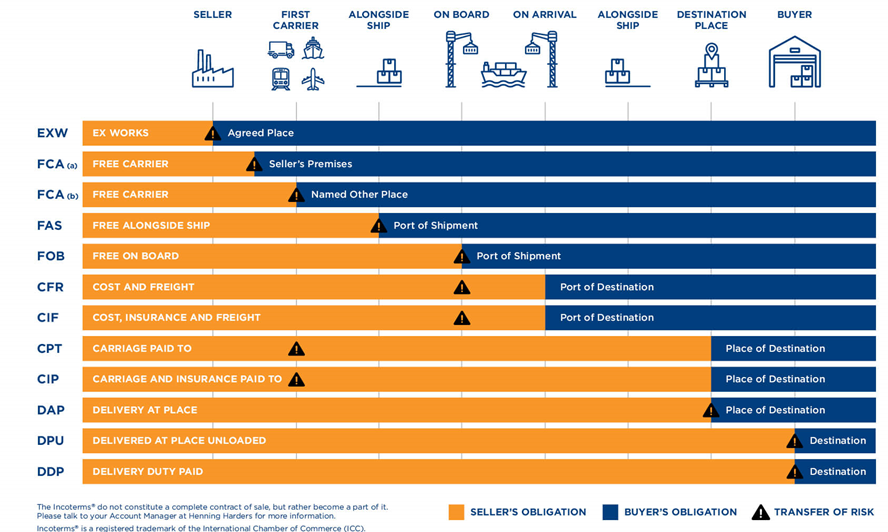
- EXW (Ex Works): the buyer arranges everything from the seller’s door. Most work for the buyer.
- FOB (Free On Board): the seller delivers the goods onto the ship at the origin port; the buyer pays the sea freight onward. Very common for imports into the Philippines.
- CIF (Cost, Insurance and Freight): the seller pays freight and insurance to the destination port, but risk passes to the buyer once the goods are on board.
- DAP (Delivered At Place): the seller delivers to the named destination; the buyer handles import customs and duties.
- DDP (Delivered Duty Paid): the seller handles everything, including import duties. Least work for the buyer.
Incoterms explorer
Pick a term to see who pays for each leg of the journey and where risk passes from seller to buyer.
Protecting your cargo
We strongly recommend it. Carriers’ liability for loss or damage is limited by international conventions, often to a small amount per kilo, which may be far less than your goods are worth. Cargo insurance covers the real value. Ask for it when you request a quote.
- Use strong export cartons or crates, and fill empty space so nothing shifts.
- Put heavy items at the bottom and palletise where you can; pallets are handled by forklift and suffer less damage.
- Wooden pallets and crates must be heat-treated and stamped to the ISPM 15 standard for most international destinations.
- Mark every package with the consignee, a reference number and handling symbols such as “this way up” or “fragile”.
More than most people expect: lithium batteries (including those inside devices), perfumes, aerosols, paints, adhesives, some cleaning products, and many chemicals. These need proper classification, packaging, labels and a safety data sheet (SDS). Declare them honestly; undeclared dangerous goods are a safety risk and can be heavily fined. We handle dangerous goods shipments every step of the way.
Note the damage or shortage on the delivery receipt before you sign, take photos of the packaging and the goods, keep everything as it arrived, and tell us right away. Claims have strict time limits, so reporting quickly protects your right to compensation.
Is it dangerous goods?
Type a product to check whether it is usually shipped as dangerous goods.
No questions match that search. Ask us directly or call +63 2 8244 6616.
Glossary
Information
- AWB
- Air waybill. The transport document for air freight.
- B/L
- Bill of lading. The transport document and receipt for sea freight; an original B/L is also the document of title.
- CBM
- Cubic metre. The unit of volume used to price sea freight.
- Chargeable weight
- The weight air freight is billed on: the higher of actual and volumetric weight.
- Consignee
- The person or company receiving the goods.
- Shipper
- The person or company sending the goods.
- CFS
- Container freight station. The warehouse where LCL cargo is packed into and unpacked from shared containers.
- Customs broker
- A licensed professional who prepares and lodges customs declarations for importers and exporters.
- Demurrage
- A charge for a full container left at the port past its free days.
- Detention
- A charge for keeping a carrier’s container too long outside the port.
- ETD / ETA
- Estimated time of departure and estimated time of arrival.
- FCL / LCL
- Full container load and less than container load.
- HS code
- The international product classification number that sets duty rates.
- Incoterms
- Standard trade terms that split costs, tasks and risk between seller and buyer.
- NVOCC
- Non-vessel operating common carrier. Sells ocean transport without owning ships.
- TEU
- Twenty-foot equivalent unit. One 20 ft container; a 40 ft container is 2 TEU.
No terms match. Try the question search above.